Trezor Login — How to Access Your Wallet Safely (Beginner → Mid)
A hands-on, human guide to logging into your Trezor device and Trezor Suite securely. Learn practical steps, threat models, jargon decoded, and best practices to keep your private keys and recovery seed truly private.
✔ PIN
✔ Recovery seed
✔ Trezor Suite
What “Trezor Login” actually means
“Trezor Login” is different from a typical website sign-in. It’s a combination of:
- Hardware authentication — you physically connect and confirm actions on your Trezor device;
- Local app handshake — usually via Trezor Suite on your machine; and
- Cryptographic signing — the device signs transactions with your private key without exposing it.
Put simply: logging into a Trezor-based wallet means proving you control the hardware (and therefore the private key) — not entering a password on a server.
Quick glossary
Seed phrase — 12/24 words that recover your wallet (offline master key).
Private key — the cryptographic secret used to sign transactions (never exposed).
Cold storage — keeping keys offline (hardware wallets are cold).
Terms used later: seed phrase, private key, firmware, 2FA, multisig.
The simple flow — logging into Trezor (in plain steps)
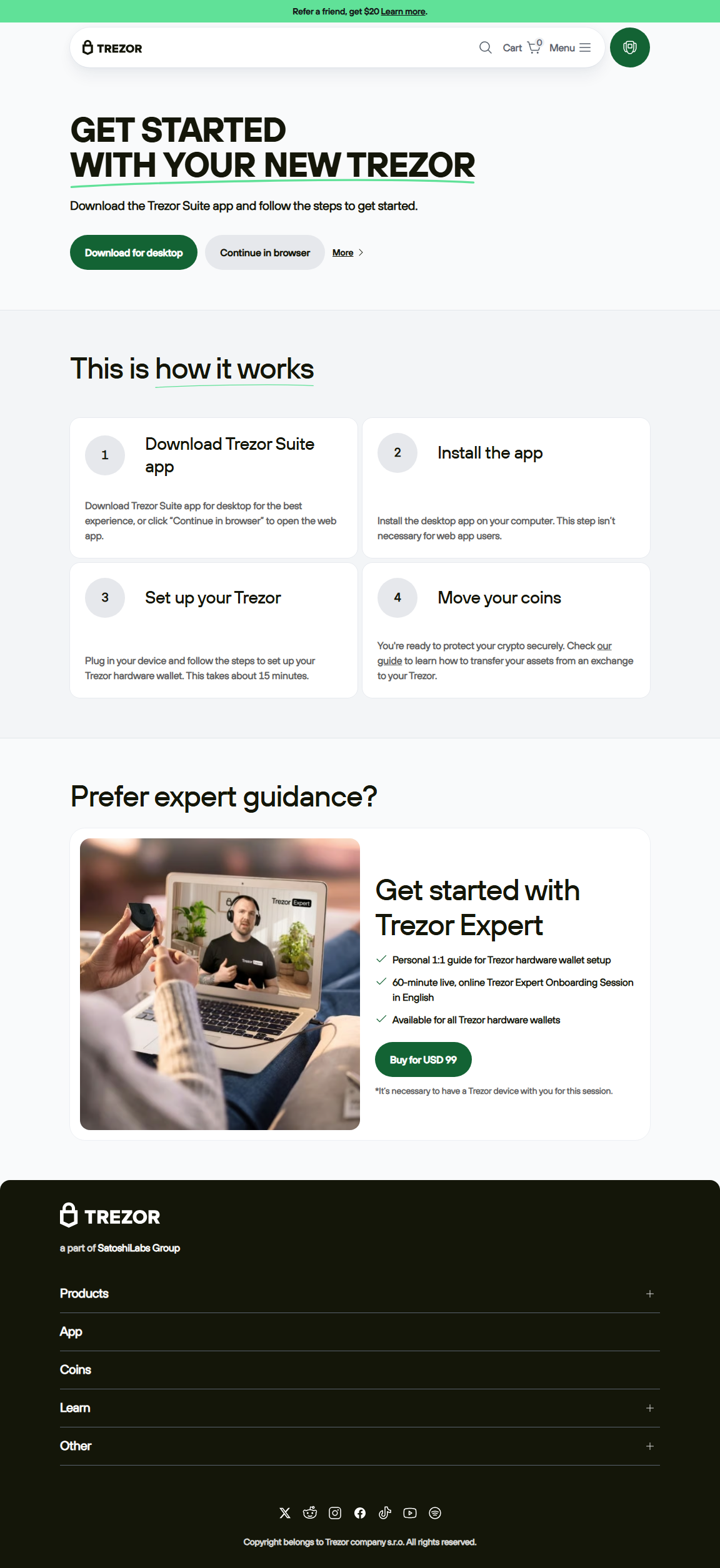
Step A — Open Trezor Suite
Start the desktop app (or web suite). The app is the user interface to the device.
Step B — Connect your Trezor
Plug via USB (or connect via an approved method). Unlock the device with your PIN.
Step C — Approve the session
Trezor Suite will detect the device and request approval. Confirm the connection on the physical screen.
Step D — Start managing assets
You’re logged in (locally). You can view balances and prepare transactions — any send requires physical confirmation.
Detailed walkthrough (with safety checks)
Before you connect: confirm you downloaded Trezor Suite from trezor.io/start, or use the signed package. Avoid searching “Trezor download” in ads — attackers often advertise fake installers.
Connection: use a clean machine if possible. Insert the USB cable, open Suite, and watch for device fingerprints (Suite displays device model & firmware).
PIN entry: always type the PIN on the device, not in the app. This prevents keyloggers from capturing your PIN.
Session approval: when Suite asks for permission, the Trezor screen will show a unique prompt — check that the prompt matches the app text before approving.
If anything looks odd (mismatched text, firmware warnings, or unexpected recovery requests), disconnect and investigate — don’t proceed.
- ✅ Firmware up-to-date
- ✅ Downloaded from trezor.io/start
- ✅ PIN typed on device
- ✅ Recovery phrase never entered into Suite
Common login problems & fixes
Device not detected
Try a different USB port/cable, ensure Suite has permission, disable browser extensions if using web Suite, or reboot your computer.
PIN forgotten
If you forget the PIN, you can reset the Trezor device, but must recover funds using your seed phrase on the same or new device.
Suspicious prompts
Never enter your recovery phrase or accept unexpected recovery prompts. Disconnect and verify with official documentation or support.
Software mismatch
Ensure the Trezor Suite version matches your OS and that firmware versions are compatible; Suite will usually guide firmware updates.
Trezor Login vs. Typical Web Logins — quick comparison
| Aspect | Trezor Login | Web Login |
|---|---|---|
| Authentication | Hardware device + PIN | Username + password (+ optional 2FA) |
| Private key exposure | Never leaves device | Stored on server (or provider-controlled) |
| Phishing risk | Low — approvals on physical screen | Higher — fake login pages can capture credentials |
| Recovery method | 24-word seed phrase (offline) | Email reset — depends on provider |
Practical security checklist (before every login)
- Confirm download source (trezor.io/start) and check digital signatures where available.
- Update device firmware via Trezor Suite when recommended — firmware integrity is crucial.
- Type PIN only on device; never in the app or browser popup.
- Never reveal or enter your recovery seed into software, messages, or websites.
- Prefer a freshly-booted, malware-free machine for large transactions.
- Consider using multisig or a secondary cold storage for very large holdings.
Expert highlight
“A Trezor login is less about convenience and more about unexposable control — if you treat your seed like the crown jewels and approve actions only on-device, you create a near-impenetrable ownership model.”
FAQ — Trezor Login (short & practical)
No — you must physically approve on the Trezor screen. Without device access and PIN, login is impossible.
Checking balances is fine, but avoid broadcasting transactions on untrusted networks for large sums.
No — the recovery seed is your responsibility. Trezor can help with device issues but not recover lost seeds.
A passphrase adds another secret layer (BIP39). It increases security but also adds responsibility — losing it can lock funds permanently.
When to consider advanced options
If you manage institutional-level funds or multiple high-value wallets, evaluate multisig setups, split-seed backups, and hardware security module (HSM) integrations. Multisig prevents a single device compromise from draining funds.
Final thoughts — login equals control, not convenience
Trezor Login is deliberately conservative: it favors absolute control and cryptographic certainty over easy, recoverable passwords. Treat every login as a security ritual — update firmware, verify sources, and never expose your seed. Do this and your crypto remains yours, forever.